
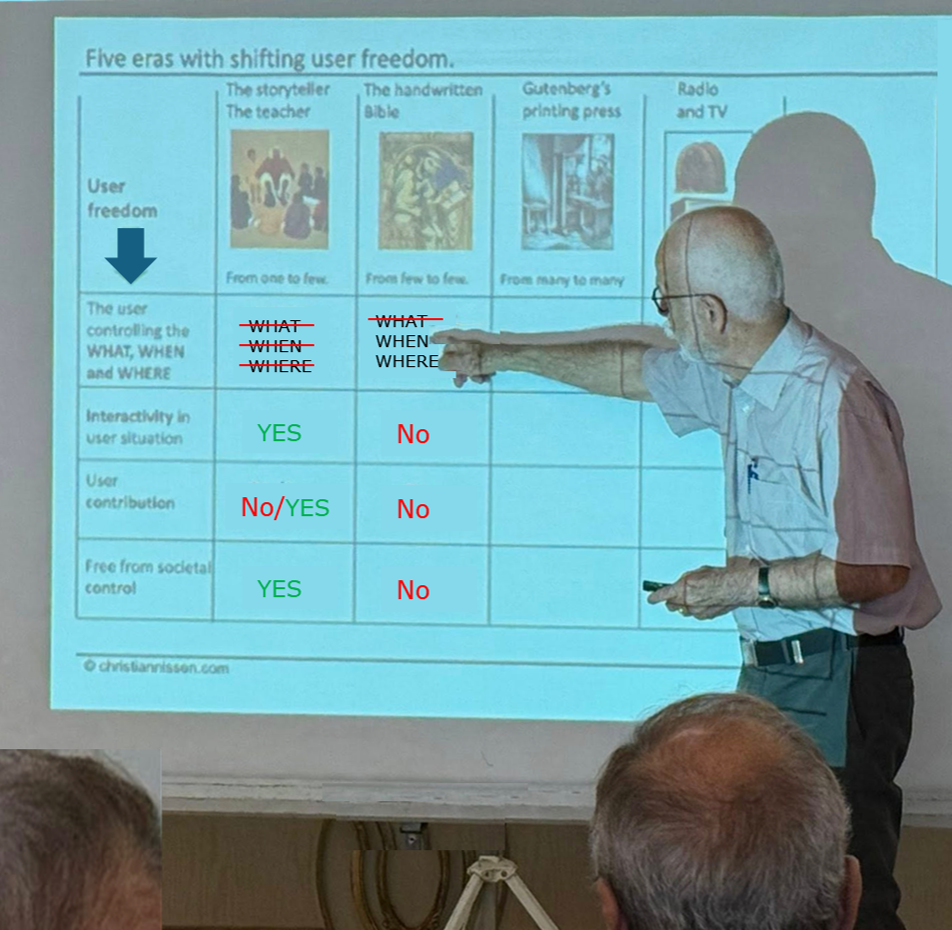
Presentation of my work with the bookchapter at the IMMAA Conference at American University Cairo October 2025 (Photo Gregory Farrell Lowe)
Report 2025.
My 2025 has been marked by overwhelming satisfaction with the new house we bought last year. But also - to a greater extent than expected - by a frustration that it was not fully renovated when we moved in. We have lived on a building site with remodelling, repairs and with planning and establishing a new garden. Almost like repairing and painting a car while you drive it.
Much of the time, this practical, physical work on the new house has been in a characteristic, perhaps fruitful, conflict with my writing work. More specifically, with the deadline for my contribution to the upcoming handbook on Public Service Media, which is planned to be published by Routledge (see last year's Report 2024). When I got tired, or got stuck in one, I sought refuge in the other, and vice versa.
The writing of the first draft was slow and somewhat erratic. But it was also a strange encounter with realizations almost like a series of revelations that made important pieces fall into place. Both in my understanding of much of what I myself was involved in at The Danish Broadcasting Corporation, DR (1994-2004) with the adaptation of flow TV to the new market competition, and what is happening right now with the gradual transition to time-shifted, VoD streaming. At the end of the summer, I handed over my second draft to the patiently waiting editor with considerable self-satisfaction.
However, the satisfaction was somewhat short-lived. In October, I participated in an International Media Management Academic Association conference hosted by The American University in Cairo, where I presented some of my ideas for the handbook chapter (see photo). The following days of presentations and discussions about other research projects in the area were fruitfully thought-provoking for me. At least I hope so. Because on the 7-hour journey home, I remembered and relived the justified criticism in the 1970s of 'structural functionalists' among development researchers. A criticism that, among other things, was aimed at their ethnocentric bias, which positioned the political-economic systems of Western (so-called "developed") countries as the ideal and final goal for the development process of all countries. Also, for the countries in the southern hemisphere.
Instructive and thought-provoking. Because it shed a relevant critical sidelight on my own potential ethnocentric bias in working with 'strategies, organization and management' for Public Service Media companies. As if they all had roughly the same overall goals and operated under the same cultural, political and economic external conditions. This can hardly be said to be the case with the countries in the northwestern corner of Europe, and is even more difficult to imagine for the rest of the continent.
This diversity is a challenge for my work on the handbook contribution, but it is necessary to ensure that the text is relevant to a wider audience of readers. Finding a constructive solution to this will - along with a handful of other projects I am involved in - become my main task in the first months of the new year. Not to forget the work of making the new house fully habitable.